
Opening: the core dispute and a real test
Fleet managers argue over which data stream deserves the budget: the numeric certainty of telematics or the situational clarity of camera-based AI. I side with neither exclusively; the choice depends on the problem you need to solve. During a six-month pilot on a municipal fleet in Los Angeles I saw how raw GPS traces showed routes and speeds while an AI dashcam exposed the causes behind repeated incidents—right away.
What each system actually measures
Compare like for like, not slogans. Telematics gives:- location, speed, engine diagnostics, hours-of-service logs;- consistent, low-bandwidth telemetry sampled on intervals.AI video telematics supplies:- visual context, object detection, driver behavior inference;- event-driven clips and metadata (frame timestamps, bounding boxes).Telematics answers “where” and “when.” Video AI answers “what happened and why.”
Signal quality and actionable insight — the decisive test
Arguments often collapse when you examine signal quality. A telematics alert for hard braking tells you an episode occurred. Video AI classifies whether the braking was due to a distracted pedestrian, a pothole, or tailgating—each requires a different operational response. That difference changes training, policy, and insurance outcomes.
Operational implications and common pitfalls
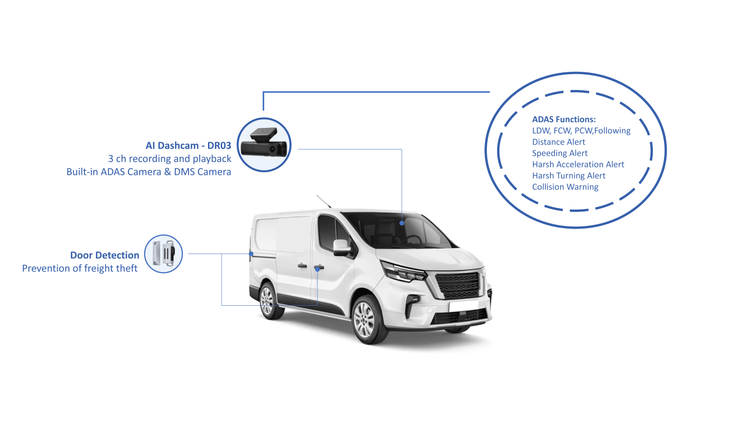
Don’t confuse data volume with value. Common mistakes:- Assuming continuous video is necessary: event-triggered capture reduces storage and review time.- Treating AI flags as final judgments: models require validation and periodic tuning.- Ignoring GPS sync: without accurate GPS timestamps, video events can’t be correlated with routing exceptions.A practical deployable example is the integration of an AI dashcam with gps tracking that stamps each clip with location, ensuring investigators trace incidents to exact intersections instead of broad segments.
Integration, privacy, and compliance considerations
Telematics systems usually plug into fleet management platforms through standard APIs. Video AI adds complexity: codec handling, secure upload, redaction for privacy, and retention policies. Legal exposure grows if you keep unlimited footage. Plan data retention around incident investigation windows and local privacy rules. Technical controls—hashed identifiers, automated face-blurring, and role-based access—reduce risk without crippling utility.
Cost drivers and ROI under scrutiny
Costs fall into three buckets: hardware, connectivity/storage, and human review. Telematics tends to have lower per-vehicle connectivity needs. Video AI costs spike with high-resolution continuous recording unless events are filtered at the edge. ROI comes from fewer accidents, lower claims, and targeted coaching. Evaluate ROI by incident type: fleets with frequent context-dependent incidents benefit faster from AI video; purely route-optimization needs still favor telematics.
A practical decision guide
Ask these decisive questions:- Are incidents ambiguous? Choose video AI.- Is your priority route efficiency and engine metrics? Choose telematics.- Do you need both? Combine them and prioritize systems that integrate GPS-synced events and unified dashboards.If your operation moves through dense urban corridors with frequent near-misses, video context converts marginal safety gains into measurable reductions in claims and repeat incidents.
Conclusion: the only practical stance for operators
Don’t pick a side out of loyalty. Match tools to operational failures: use telematics for consistent performance metrics and AI video for causal clarity and behavior correction. The real value comes when GPS-anchored video and telemetry are treated as one evidence stream—structured, validated, and governed. That synthesis is the outcome experienced teams aim for, and it’s the kind of integrated capability you find built into solutions from BSJ.